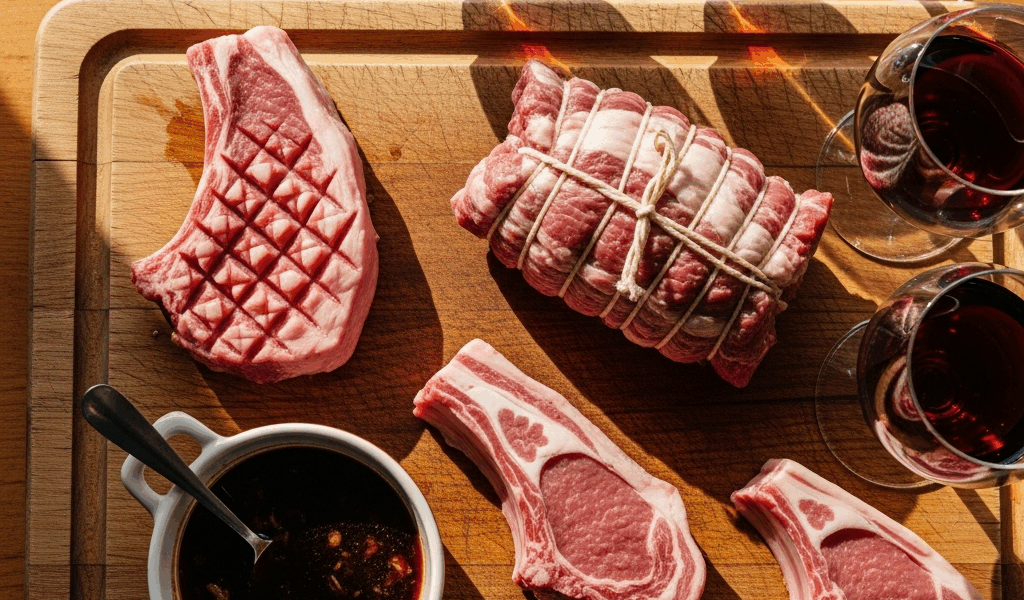
Why Cooking Method Changes the Pairing
Wine and lamb pairing has gotten complicated with all the generic advice flying around. “Drink red wine with lamb” — sure, thanks, incredibly helpful. As someone who spent three years working wine lists at a restaurant in Portland, I learned everything there is to know about this subject. Today, I will share it all with you.
Here’s what nobody tells you: the lamb is almost secondary. Grilled lamb chops taste nothing like braised ones. The char on a seared chop creates bitter compounds. The silky, sauce-laden meat from a braise is practically a different ingredient. Fat rendering, crust development, sauce composition — these are the real variables. Find your cooking method below and skip the one-size-fits-all nonsense.
Grilled Lamb Chops — Go Bold and Smoky
Grilling does something almost violent to lamb. High heat chars the exterior fast, renders fat in minutes, and leaves those slightly acrid bits that will absolutely flatten a delicate wine. A bottle needs to match that aggression — not apologize for it.
Syrah is the obvious play. Northern Rhône Syrah specifically — something from Hermitage or Côte-Rôtie. Dark fruit, black pepper, leather. Enough grip to actually complement the char rather than get knocked sideways by it. Domaine Guigal’s Hermitage runs around $65–$85. Not cheap. But one bottle covers four people generously, so do the math.
Malbec from Mendoza works just as well if Syrah feels too austere for the occasion. Similar dark fruit profile, slightly fruitier, a touch less severe. You’ll spend $20–$35 on something reliable — Altos Las Hormigas or Finca Decero are both solid bets. I stumbled onto this pairing by accident when my grill broke mid-summer and I had to pivot from what I’d originally planned. The Malbec ended up being the better call for the specific char level we’d hit that night. Don’t make my mistake of overlooking it.
Serve around 62–64°F. Too warm and the alcohol overtakes the chop entirely. Too cold and the wine tastes thin and mean.
Roasted Lamb Chops — Classic for a Reason
Roasting is gentler. The oven renders fat steadily over time, the meat develops a golden crust rather than a bitter char, and the drippings become sauce — savory, meaty, deeply umami. That’s what makes roasted lamb so endearing to us home cooks. It rewards patience without demanding technical precision.
Cabernet Sauvignon does this effortlessly. Earthy undertones, solid structure, a natural affinity for roasted red meat. Bordeaux-style blends work here too. You don’t need to spend heavily — a Napa Valley Cabernet in the $35–$50 range performs beautifully. Vintage matters more than price point, honestly. 2019 and 2018 are both drinking well right now, ripe enough to match roasted lamb without turning aggressively tannic.
Rioja Tempranillo is the other winning option, particularly if you’ve built an herb crust. Rosemary, garlic, thyme — these aromatics nudge the whole pairing toward Spain more naturally than California Cab ever will. Tempranillo has a slightly dusty, earthy quality that echoes roasted garlic and dried herbs almost perfectly. A Reserva-level Rioja — that’s three years aged, minimum two in oak — will run $25–$45 and deliver more complexity than the basic Joven bottlings at half the price.
I once paired roasted lamb chops with a Grenache-based Côtes du Rhône simply because it’s what I had open. The earthiness surprised me. Good surprised. Roasting doesn’t demand aggressive tannic structure the way grilling does, so there’s room to experiment without the whole thing falling apart.
Braised Lamb Chops — Earthy Wines Win Here
Probably should have opened with this section, honestly. Braising trips up more people than any other method — because the instinct is to reach for something big and structured, and that instinct is wrong.
But what is braised lamb, really? In essence, it’s meat slow-cooked in wine, broth, and aromatics until it’s barely holding together. But it’s much more than that — the cooking liquid reduces to a thick, glossy sauce that becomes the dominant flavor. The wine pairing shouldn’t try to compete with that. It should disappear into it.
Grenache-based blends or a straightforward Côtes du Rhône are the safe anchors here. Soft tannins. Earthy without being aggressive. A standard Côtes du Rhône costs $12–$18 and handles braised lamb beautifully — because it was largely made to drink alongside exactly this kind of meal. No pretense. Just natural alignment.
Heavy tannic reds are a trap. A young Barolo or a big California Cabernet will turn bitter against long-cooked meat and rich sauce. I’m apparently a slow learner on this front, and a Napa Valley Cabernet from a difficult vintage taught me that lesson the hard way. The pairing tasted almost medicinal by the end of the meal. Don’t make my mistake.
Stay medium-bodied and earthy. A Châteauneuf-du-Pape works if you want more structure — expect $30–$60. But for braised lamb, the $15 Côtes du Rhône honestly outperforms it. The wine’s simplicity is an asset here, not a limitation.
Pan-Seared Lamb Chops — When You Want Something Lighter
Pan-searing keeps everything leaner. No long fat render like roasting. No char-heavy aggression like grilling. No sauce reduction like braising. The chop stays relatively bright, and the focus lands squarely on the meat itself. So, without further ado, let’s dive in — because the wine choice shifts accordingly.
Pinot Noir is the natural call. Silky tannins, lively acidity, red fruit flavors — cherry, strawberry, sometimes a little cranberry — rather than the dark fruit that grilled preparations demand. A good Pinot from Oregon or Burgundy runs $25–$50. Willamette Valley bottles lean slightly richer. Burgundy goes earthier. Either works. I’m apparently a Willamette person — Elk Cove or Adelsheim both work for me while heavily extracted California Pinot never quite does with this dish.
Sangiovese is a legitimate alternative — specifically a medium-bodied version, not a structured Brunello. Italian reds bring bright acidity that keeps pan-seared lamb from feeling heavy. A Chianti Classico ($18–$35) or a Vino Nobile di Montepulciano will both deliver. That acidity matters when you’re not relying on char or sauce to carry the meal.
Mint or citrus sauces? Lean even harder toward Pinot or Sangiovese. I’ve served pan-seared lamb with a lemon gastrique alongside a Chablis — unoaked Chardonnay, around $22 a bottle — which isn’t a conventional pairing at all. But both the sauce and the wine were hitting the same acidity register, and the whole thing just clicked.
Quick Reference
- Grilled: Syrah (Northern Rhône) or Mendoza Malbec
- Roasted: Cabernet Sauvignon or Rioja Tempranillo
- Braised: Côtes du Rhône or Grenache blends
- Pan-Seared: Pinot Noir or Sangiovese
The pairing that works is the one that matches what’s actually on your plate. Cooking method shapes flavor profile far more than the cut of meat ever will. Match the wine to the heat level, the sauce, the char — not just the protein on the label.

Stay in the loop
Get the latest pairing with wine updates delivered to your inbox.