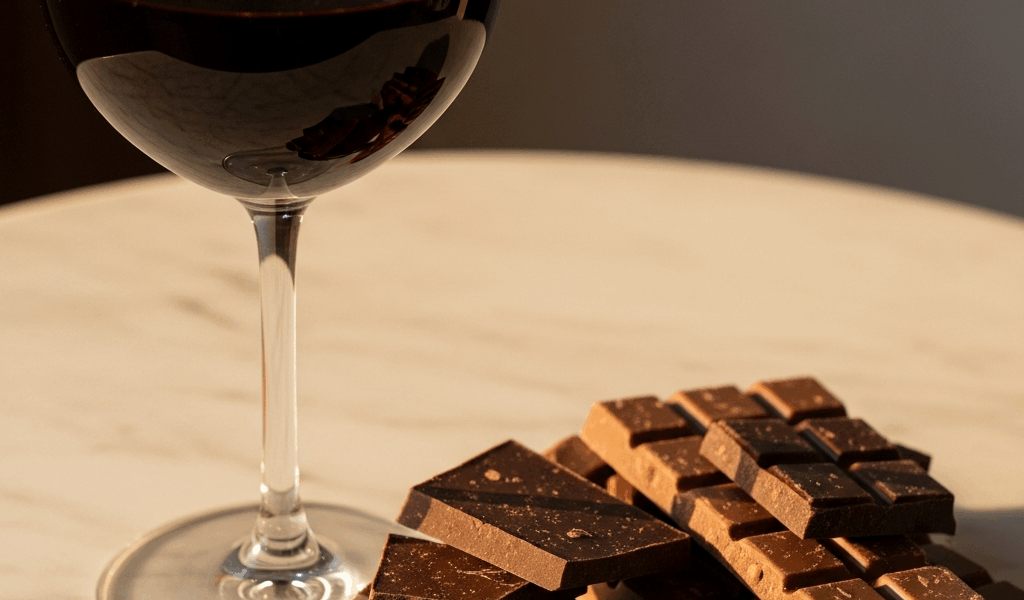
Why Wine and Chocolate Usually Taste Terrible Together
Wine and chocolate pairings have gotten complicated with all the contradictory advice flying around. As someone who spent three years on the floor of a wine retail shop, I learned everything there is to know about why these pairings fail. Today, I will share it all with you.
The short version: a customer would walk in, grab a $40 bottle of Cabernet Sauvignon, go home, crack open a dark chocolate bar, and come back seven days later describing something metallic and weirdly bitter. I’d nod. Smile. Offer nothing useful. That went on for longer than I’d like to admit.
So what’s actually happening? In essence, it’s a sweetness mismatch — when wine is less sweet than the chocolate it’s paired with, both taste worse. But it’s much more than that. The chocolate strips the wine down, makes it feel harsh and dry. The wine returns the favor by making the chocolate taste hollow. Nobody wins.
Tannins are the other piece. They’re the compounds in red wine responsible for that mouth-drying sensation — like biting into a tea bag, basically. Dark chocolate carries tannins too. Stack them together without the right balance and you get something puckering and metallic. Your palate isn’t broken. The pairing is.
The fix is genuinely simple: find wine that’s sweeter than the chocolate, or fruity enough to push through the tannin collision, or ideally both. Everything else in this article is just applying that one idea to different chocolate types. So, without further ado, let’s dive in.
Dark Chocolate Needs a Wine With These Qualities
Dark chocolate is the hardest case. Probably should have opened with this section, honestly — it’s where most people get burned first.
I learned this personally after confidently pointing a customer toward a 2015 Napa Cabernet to go with her 85% cacao Lindt bars. She came back two days later. Politely furious. I had no defense.
Most dry reds fail here. Pinot Noir seems like it should work — lighter body, less aggressive tannin, more finesse. It doesn’t work. The chocolate still steamrolls it, leaves the wine tasting thin and almost watery. Don’t make my mistake recommending it.
What actually holds up are wines that are either fortified and sweet or red wines carrying enough ripe fruit to fight back against bitterness. That’s the real threshold.
Ruby Port is the most dependable option. It’s a fortified wine from Portugal — around 19% alcohol — with dark berry and plum flavors and real, noticeable sweetness. Paired with 70% dark chocolate, something clicks. They balance instead of bicker. A solid bottle runs $20 to $30. Avoid anything under $15 — I’m apparently overly sensitive to cheap ruby port and find it flat and syrupy, but honestly most people agree on that one.
Banyuls is a French fortified wine most people haven’t encountered. Made in Catalonia from Grenache grapes, it carries this dark cherry and licorice depth that makes dark chocolate taste richer rather than more bitter. That’s what makes Banyuls endearing to us chocolate-pairing enthusiasts — it’s not fighting the chocolate, it’s amplifying it. Expect to spend $25 to $35. Look for labels reading “Banyuls Rimage” or simply “Banyuls” — both perform the same way.
For dry reds, skip Cabernet and Merlot entirely. Zinfandel is your move. Look specifically for bottles labeled “Old Vine” or showing alcohol at 15% or above — that signals ripe grapes and the kind of jammy, fruit-forward character dark chocolate actually needs. California producers like Ravenswood and Ridge make reliable versions at $18 to $25.
One label trick worth knowing: if the tasting notes include words like “bright,” “elegant,” or “structured,” walk away. You want “ripe,” “rich,” “jammy,” or “intense fruit.” That’s the signal the wine has enough character to hold its ground.
Milk Chocolate Pairings That Actually Work
Milk chocolate is sweeter, creamier, and — good news — it opens up your options considerably.
Pinot Noir finally earns its place here. The chocolate’s sweetness softens the tannins, while the wine’s acidity cuts through all that fat. A decent Pinot from Oregon’s Willamette Valley or California’s Santa Barbara County lands at $18 to $35. Skip anything under $12 — it tastes thin and unconvincing next to chocolate, like it’s apologizing for being there.
Demi-sec sparkling wine is another solid choice. “Demi-sec” means half-dry — noticeably sweet but not aggressively so. The bubbles scrub your palate clean between bites, which matters more than people realize. Prosecco labeled “demi-sec” or “abboccato” works well and costs $12 to $18. This is the move if you want something that feels celebratory without overthinking it.
Ruby Port — yes, again — still works beautifully with milk chocolate. The richness aligns in a way that feels almost obvious once you try it. You can go slightly cheaper here than with dark chocolate. $18 to $25 is fine.
Big Cabernets and Merlots are popular attempts here. Skip them. The wine and chocolate are both competing for the same heavy, tannic space. It tastes dull and crowded rather than complementary. I watched customers try this combination constantly. It never improved.
White Chocolate and Wine Is Tricky — Here Is Why
White chocolate contains zero cocoa solids. That one fact changes everything about the pairing approach.
But what is white chocolate, really, in pairing terms? In essence, it’s fat and sweetness — dairy-forward, buttery, rich. But it’s much more than that when you’re choosing a wine, because you’re no longer managing tannin conflicts at all. You’re matching texture and cutting through richness.
Moscato d’Asti is the obvious starting point. It’s lightly sweet, low alcohol — roughly 5% to 6% — with a delicate floral character that doesn’t compete with white chocolate’s richness, it just floats alongside it. Special without being fussy. Bottles run $12 to $16.
Late-harvest Riesling works equally well. Look for German or Alsatian bottles labeled “Auslese” or “Sélection de Grains Nobles.” These come from grapes picked late in the harvest cycle — concentrated, sweet, and carrying enough natural acidity to keep the pairing from feeling like dessert piled on dessert. Typically $18 to $30, and worth every dollar.
Sauternes — the legendary dessert wine from Bordeaux — is technically the ideal match. It’s also $30 to $60 a bottle and probably feels like overkill on a Tuesday night. Save it for occasions that deserve it.
The mistake I saw constantly: oaked Chardonnay. White wine with white chocolate seems logical on paper. Frustrated by slow sales one afternoon, I actually tested this myself using a $22 bottle of heavily oaked California Chardonnay and a Valrhona Ivoire bar — one of the better white chocolates available. The result was awful. Buttery colliding with buttery, tannin from the oak overwhelming the delicate chocolate. I sold a lot of those bottles to confused customers before I figured that out. Don’t make my mistake.
Chocolate Desserts With Fillings Change the Pairing
A chocolate with something inside it — raspberry, caramel, mint, hazelnuts — isn’t just chocolate anymore. The filling shifts the entire flavor profile.
Raspberry-filled dark chocolate pairs better with Pinot Noir than Port. The raspberry element in both the wine and the filling creates a natural echo that works surprisingly well. Oregon Pinot at $20 to $28 hits the right note.
Caramel-filled chocolate calls for Ruby Port or Banyuls. The caramel’s sweetness slots neatly alongside fortified wine’s richness. Same price range as before — no need to overthink it.
Mint-filled dark chocolate is honestly a wine graveyard. Mint and wine clash in ways that aren’t fixable through clever selection. If you absolutely must pair something, reach for a demi-sec sparkling — the bubbles and sweetness create enough distraction to make it tolerable. $12 to $18. That’s what makes demi-sec endearing to us pragmatic pairers — it solves problems it was never designed to solve.
Nut-filled chocolates: match by the nut. Hazelnut or almond pairs naturally with late-harvest Riesling. Salted nuts pair with Ruby Port — the salt actually amplifies the fortified wine’s richness in a way that feels almost engineered. That was a discovery that came from a slow Saturday afternoon, a bag of salted mixed nuts, and a half-empty bottle of Graham’s Six Grapes. Genuinely one of the better accidents I’ve stumbled into.

Stay in the loop
Get the latest pairing with wine updates delivered to your inbox.