Why Pizza and Wine Pairing Has Gotten Way More Complicated Than It Needs To Be
Pizza and wine pairing has gotten complicated with all the conflicting advice flying around. Every guide says something different. Drink Italian reds. No, drink whatever you want. Acidity matters. No, it doesn’t. Honestly, most of those guides are skipping the part that actually matters — what’s sitting on top of the pizza.
As someone who has ruined more than a few Friday nights with the wrong bottle, I learned everything there is to know about matching wine to pizza toppings the hard way. Today, I will share it all with you.
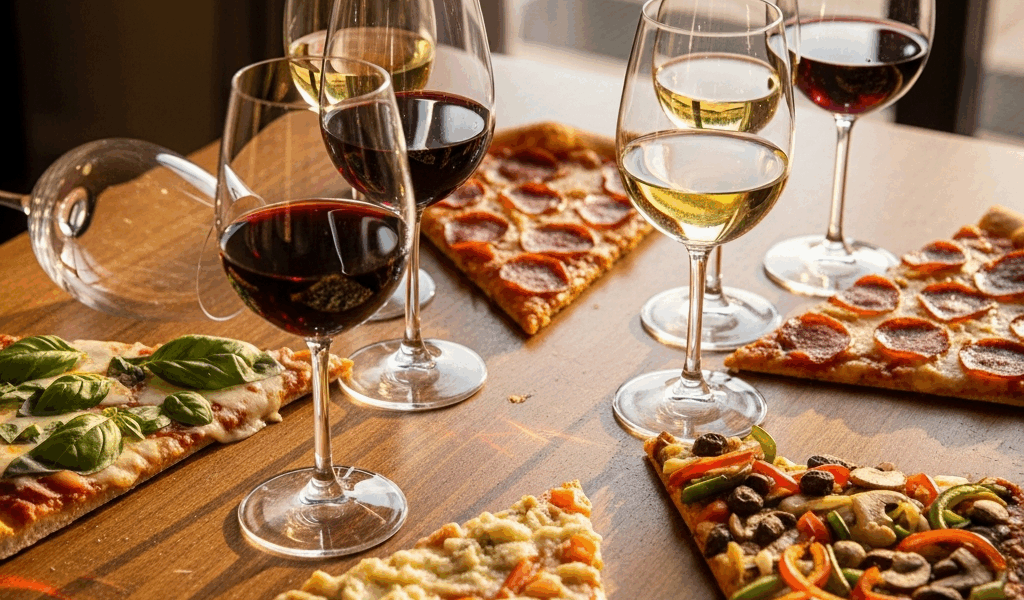
But what is pizza, really, from a pairing standpoint? In essence, it’s a collision of competing flavor demands on a single plate. But it’s much more than that. You’ve got acidic tomato sauce pulling one direction, fatty melted cheese pulling another, and then whatever toppings are doing their own thing on top. A Margherita and a BBQ chicken pizza might look similar on a menu. They are not asking the same thing from your wine glass. Not even close.
The actual rule is simpler than anyone makes it sound. Match the wine’s acidity and weight to whatever topping is dominating — not the crust, not even the cheese. The tomato sauce on a pepperoni pizza should drive your choice. The cream sauce on a white pizza changes the whole game. So, without further ado, let’s dive in.
Classic Red Sauce Pizzas — Margherita and Pepperoni
Tomato-forward pies need high-acid reds. This is the easiest category. It’s also where most wine-pizza pairings actually succeed, which is probably why so many guides just stop here.
Reach for a Chianti Classico, a Barbera, or a straightforward Sangiovese. Tomato sauce carries natural acidity — the wine mirrors it, so neither one tastes sharp or aggressive against the other. They’re speaking the same language. A $12–18 bottle of Chianti Classico from Ruffino or Brolio cuts through the cheese richness and balances the salt without making anyone at the table regret the decision. That’s what makes this pairing endearing to us pizza lovers.
Pepperoni needs a slight adjustment. The rendered fat and spice want something with more fruit-forward character. Barbera d’Asti — usually $14–22 — handles this better than straight Sangiovese. Softer tannins don’t fight the heat. The darker fruit notes complement the meat without tasting thin or washed out.
If you refuse to touch red wine: Vermentino works. It’s a crisp Sardinian white and honestly the only white option that doesn’t taste completely lost against tomato sauce and mozzarella. Most people won’t reach for it here. Their loss.
White Pizza and Cream-Based Pies
No tomato sauce means no acid anchor. The wine has to provide all the cutting power on its own. Probably should have opened with this section, honestly, because this is where the most damage gets done.
I’m apparently someone who learns lessons the expensive way, and a buttery Chardonnay works for me on roasted chicken but never on white pizza. I ordered a ricotta and spinach white pie, opened a $28 bottle of oaked Chardonnay I’d been saving for something, and discovered the two had absolutely nothing to say to each other. The wine disappeared into the cream sauce. Everything tasted soft, flat, a little sad. Don’t make my mistake.
Go crisp instead. Pinot Grigio, Soave, or an unoaked Chardonnay — something with genuine backbone and a clean finish. The acidity cuts through ricotta or béchamel. A $10–14 Soave does this job perfectly. The slight salinity also echoes garlic or caramelized onions on top in a way that actually makes sense on the palate.
One red does work here, though it’s unconventional. A light Pinot Noir — specifically a cool-climate bottle from Oregon or Burgundy — suddenly makes sense if your white pizza has mushrooms or truffle oil. The earthy, subtle tannins don’t overpower the cream sauce. The lighter body matches the pizza’s weight. It’s the kind of pairing that makes people at the table ask what you just poured them.
BBQ Chicken Pizza and Other Sweet-Sauce Pies
Sweet sauce is a pairing trap. This is the troubleshooting core of the whole conversation — and the place where most people go wrong at least once before they figure it out.
Frustrated by yet another metallic, bitter glass of wine, I finally started paying attention to what was actually happening. Heavy Cabernet Sauvignon clashes with BBQ sauce sweetness using a very specific mechanism: the tannins amplify the sugar and create a metallic finish that makes both the food and the wine taste worse. I’ve watched this happen at parties. Someone opens something they consider a “nice” red — a $35 Cab, maybe — pours it for everyone eating BBQ chicken pizza, and the whole table goes quiet in the wrong way.
Reach for off-dry Zinfandel ($12–20) or a fruity Grenache instead. The fruit-forward character leans into the sweetness rather than fighting it. A California Zinfandel from Ravenswood works especially well — the wine carries a slight residual sweetness that harmonizes with the sauce rather than clashing against it. The berry notes and alcohol warmth also complement the char on the crust and the spice in the sauce. That’s what makes Zinfandel endearing to us BBQ pizza people.
Want to get creative? Lambrusco — the slightly sweet sparkling red from Italy, usually around 11% alcohol — is surprisingly effective here. It’s fun. The bubbles cut through the richness. It’s not what anyone expects. It works every time.
Veggie Pizza and Meat Lover’s Pizza — Opposite Ends of the Spectrum
These two sit on completely opposite sides of the flavor map. They demand opposite approaches.
Veggie pizzas — roasted peppers, artichoke, olives, caramelized onions — are lighter and cleaner. They’re not trying to be rich. Pair them with Vermentino, Grüner Veltliner, or a light Gamay. A $9–14 Grüner Veltliner from Austria has exactly the right profile: crisp, mineral, with a white pepper note that echoes anything spicy on top. These wines have the acidity to bounce off vegetables without the weight that would drown them. Match delicacy with delicacy. That’s the whole idea.
Meat Lover’s pizza is the opposite problem entirely. Pepperoni, sausage, bacon, sometimes ham — fat and salt piled high. This needs a structured red with actual tannin to cut through the richness. A Montepulciano d’Abruzzo ($12–18) or a Côtes du Rhône blend has the backbone to stand up without getting flattened. The tannins grip the palate, which is exactly what you need against that much pork fat. This new understanding of tannin as a tool — not just a texture — eventually evolved into the pairing instinct that enthusiasts develop and rely on today.
The cheat sheet: High-acid Italian red for red sauce pizza — Chianti, Barbera, Sangiovese. Crisp Italian white for white pizza — Pinot Grigio, Soave. Off-dry fruit-forward red for sweet sauce — Zinfandel, Grenache. Crisp white for veggie pizzas. Structured red for meat-heavy pizzas. This covers 90 percent of actual pizza nights. The other 10 percent is experimentation. That part’s fun.


Stay in the loop
Get the latest pairing with wine updates delivered to your inbox.