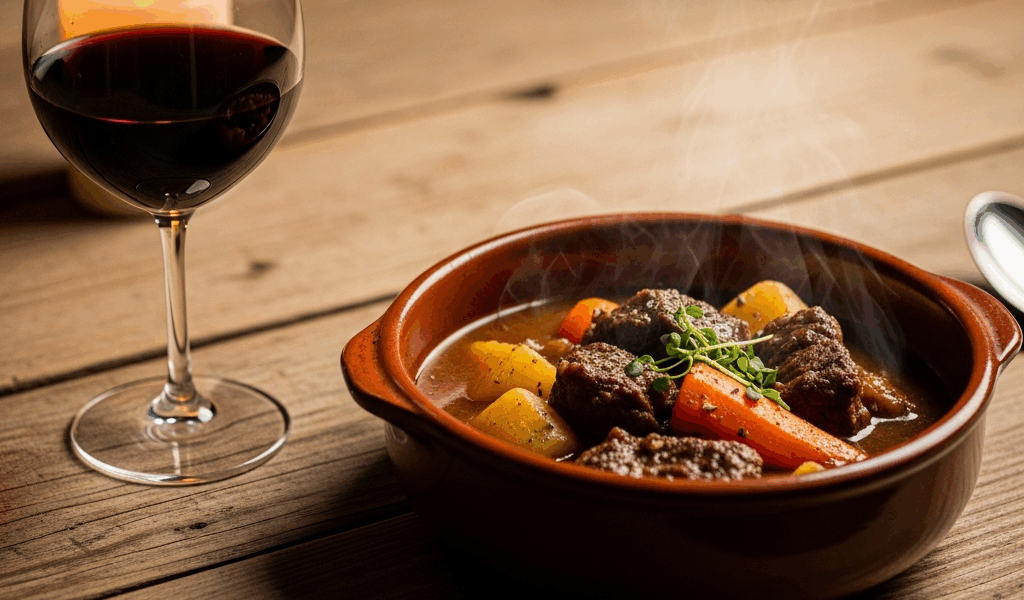
The beef stew is two hours into a braise. The house smells incredible. You reach for the wine rack and grab a big Cabernet because beef equals big red, right? Stop. Beef stew is not a grilled steak. The braising liquid, the root vegetables, and the long cooking time have shifted the flavor profile. What you want is something earthier, more moderate, and less tannic. Here are 5 bottles worth opening.
[foxdog-disclosure]Why Beef Stew Needs a Specific Wine
A grilled ribeye has charred fat, high heat flavor, and the protein-tannin interaction that makes Cabernet Sauvignon sing. Beef stew has none of that. The meat has braised for hours, the root vegetables — carrots, parsnips, celery root — have added sweetness, and the braising liquid has created a rich, savory broth that mellows everything.
What works with this profile: medium-bodied reds with earthy notes that complement those root vegetables. Wines with enough fruit to match the richness of the braising liquid without overpowering it. Wines with enough structure to avoid getting lost in the flavors but not so much tannin that they turn harsh without fat to soften them.
What does not work: very light reds get lost. Overly tannic wines become harsh without the charred fat of a grilled steak. Oaky whites go in entirely the wrong direction.
The Best Varietals: Earthy and Medium-Bodied
Pinot Noir (Burgundy style). The gold standard for beef stew. Earthy, medium-bodied, red cherry and forest floor notes that mirror the mushroom and root vegetable flavors in a well-made stew.
Cotes du Rhone (Grenache-based blends). Slightly more body than Pinot Noir, with southern French earthiness that works beautifully. Affordable and consistently excellent with braised dishes.
Chianti (Sangiovese). Earthy, medium acidity. The tomato and earthy notes of Sangiovese work particularly well with tomato-based beef stews.
Zinfandel (California). For richer, more robust American-style stews — the jammy fruit and pepper notes complement a stew with deeper, bolder seasoning.
Malbec (Argentina). Medium-bodied, plum and violet notes. Excellent value and an easy crowd-pleaser with any braised beef dish.
5 Specific Bottles: Budget to Splurge
Best value ($14-18): Famille Perrin Cotes du Rhone Villages. Consistently excellent Grenache, Syrah, Mourvedre blend. Earthy, spiced, and built for exactly this kind of food. Hard to beat at this price.
Budget red ($12-14): Chateau Ste. Michelle Merlot Columbia Valley. Approachable, smooth, slight earthiness. Does the job without making you think too hard about it.
Mid-range ($18-22): Meiomi Pinot Noir California. Consistent quality with a strawberry and earth balance that pairs naturally with braised beef and root vegetables.
Pacific Northwest pick ($20-25): Sokol Blosser Evolution Red Oregon. Earthy Oregon red blend with enough complexity to elevate the meal.
Splurge ($35-45): Elk Cove Pinot Noir Willamette Valley. Oregon Pinot at its best — earthy, structured, and memorable. This is the bottle for when the stew is your grandmother’s recipe and the night calls for something special.
Cooking Wine vs Drinking Wine
The wine in your stew and the wine in your glass are different decisions. For cooking: use a dry red with some body — Merlot, Cab, or Cotes du Rhone. Never use anything labeled “cooking wine” — it contains salt and additives that ruin the flavor. Use a wine you would drink, but not your best bottle. A $10 to $15 bottle is appropriate for the braising liquid.
The serving wine should be a step up in quality. If you cook with a $12 Merlot, serve a $20 Pinot Noir alongside. They do not need to match.
One Wine for Cooking and Serving
If you want to open one bottle for both purposes: Cotes du Rhone. Use one cup in the stew, serve the rest at the table. The Grenache earthiness amplifies through cooking and the wine does not become astringent when reduced. Famille Perrin or Guigal Cotes du Rhone at $14 to $18 handles both roles well.
Avoid Cabernet Sauvignon for dual use — the tannins can become harsh when reduced in cooking liquid. Merlot is safe for both. Pinot Noir is excellent for serving but loses its delicate aromas when subjected to high-heat braising.
[foxdog-inline-cta asin=”B0028LI9JS” title=”Rabbit Wine Aerator and Pourer” tag=”pairingwithwine-20″]

Stay in the loop
Get the latest pairing with wine updates delivered to your inbox.