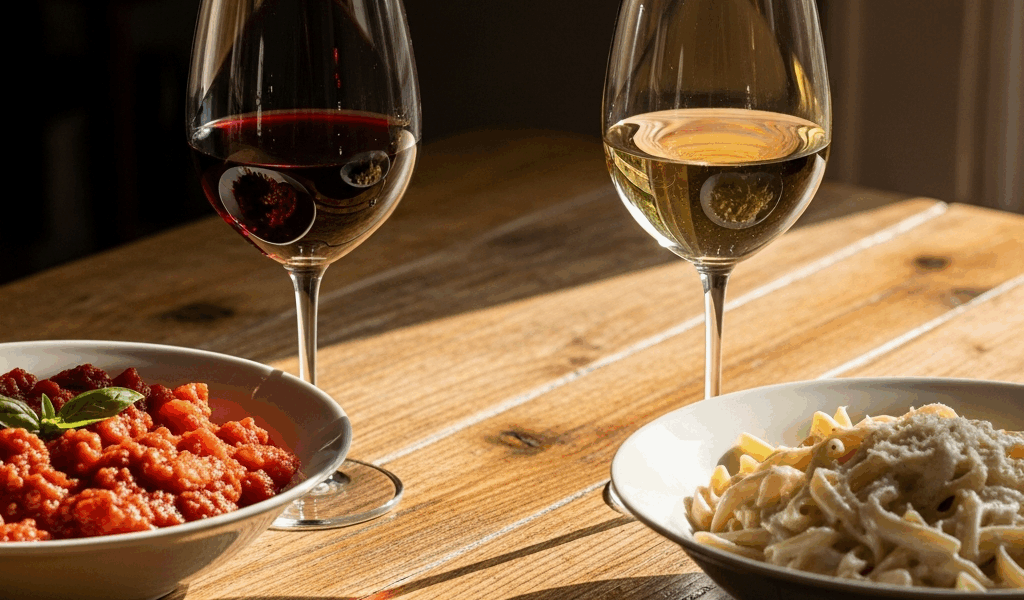
Wine Pairing with Pasta — Red or White Depends on the Sauce
Wine pairing with pasta has gotten complicated with all the “red wine with pasta” noise flying around. As someone who spent three years as a sommelier at a mid-range Italian restaurant in Portland, I learned everything there is to know about this subject. Today, I will share it all with you.
Here’s the thing nobody tells you: the pasta shape is irrelevant. Completely irrelevant. Penne, rigatoni, spaghetti — none of that determines your wine choice. The sauce does. Everything flows from the sauce, and once you accept that, the whole pairing puzzle gets a lot simpler.
I watched customers order Malbec with carbonara. Pinot Noir with pesto. All because someone told them “red wine with pasta” and they filed that away as gospel. That’s how myths get started — and that’s how dinners get ruined. The sauce-first framework is the only one that actually works.
Red Sauce Pasta — Match the Acidity
Probably should have opened with this section, honestly. It’s the most forgiving category, the most common, and the one where people almost get it right — then stumble at the last step.
Marinara and bolognese get their character from tomatoes. Tomatoes are acidic. Most people clock this and order red wine, which is directionally correct. But not all reds work here, and learning that distinction the hard way cost me an embarrassing moment during my first month at the restaurant.
I recommended a big California Cabernet — a Caymus Vineyards 2019, to be specific — to someone eating spaghetti bolognese. The pairing was flat. Dull. The wine’s heavy tannins clashed with the sauce’s acidity, and neither one tasted right anymore. The customer was polite about it. I was mortified. Don’t make my mistake.
Tomato-based sauces sit around 3.5 to 4.0 pH. You need wines with enough natural acidity to operate in that same range. High-acid reds. That eliminates most New World Cabs immediately.
Chianti — The Default Choice
Start with Chianti. But what is Chianti, really? In essence, it’s a Tuscan red built primarily on Sangiovese grapes. But it’s much more than that — it’s a wine that was essentially engineered over centuries to sit next to a tomato-based sauce and behave perfectly.
A basic Chianti Classico from Tuscany will run you $16–$28 and will save you every single time. The mineral edge and bright acidity in Sangiovese are exactly what marinara sauce wants. The wine amplifies the sauce rather than fighting it. Tannins are moderate. The flavor profile — cherry, earth, a faint whisper of leather — complements without competing.
My go-to recommendation: Gabbiano Chianti Classico Riserva. Around $22 at most wine shops. Aged in oak, it carries enough structure to handle a heavier bolognese, but the acidity keeps everything from feeling heavy. I’ve never had a complaint when this bottle landed on the table.
Sangiovese — The Deeper Version
Want more personality? Go straight to pure Sangiovese. Chianti is mostly Sangiovese anyway, but when you buy it labeled as Sangiovese — especially from Tuscany or Umbria — you’re getting the grape without the blending regulations that govern Chianti production.
Brunello di Montalcino is Sangiovese at its most refined. It’s expensive, usually $40–$80 a bottle, but if you’ve spent four hours building a bolognese, this is the bottle you open. That’s what makes Brunello endearing to us sauce-obsessed people — it meets patience in cooking with patience in aging.
There’s a sensible middle ground: Vino Nobile di Montepulciano. Also Sangiovese-based, also Tuscan, but solid bottles land between $18–$35. Darker fruit than basic Chianti, the same acidity you need, and a dryness that keeps the pairing clean.
Barbera — The Underrated Option
Barbera is from northern Italy — Piedmont, specifically — and it is muscular. The acidity is almost aggressive in many bottles. This is where you go when your bolognese is genuinely thick, genuinely rich, genuinely demanding a wine that won’t blink.
A Barbera d’Alba ($15–$30) brings dark cherry flavors and enough punch to stand up to meat-heavy sauces. The tannins are present but fine-grained. The acidity is the whole point.
I’m apparently a slow learner, and Chianti worked for me while Barbera never even crossed my mind for years. I overlooked it completely, assuming elegance mattered more than usefulness. Stupid assumption. Barbera isn’t trying to be elegant. It’s trying to be useful. It succeeds entirely.
Cream and Alfredo Sauce — White Wines Shine
This is where I see the most failures. Red wine with cream sauce is genuinely bad — not as a matter of preference, just as a matter of chemistry. Tannins interact poorly with fat and dairy. The result is a harsh, metallic finish that ruins both the wine and the sauce simultaneously.
Cream sauces need whites. Full stop. So, without further ado, let’s dive in.
Chardonnay — The Rich Match
Fettuccine Alfredo is butter, cream, and Parmigiano-Reggiano. That’s it. Rich, fatty, salty, heavy. You need a white wine with enough body to match that weight — at least if you want the pairing to feel complete rather than lopsided.
Oaked Chardonnay does this perfectly. The barrel aging adds vanilla, buttered toast, subtle roundness — all of which complement Alfredo’s profile rather than crashing into it. Unoaked Chardonnay will taste thin and reedy by comparison. You want that roundness.
Specific bottle: Kendall-Jackson Vintner’s Reserve Chardonnay. About $18 at Total Wine or most grocery stores with a decent wine section. It’s unapologetically oak-forward with the buttery profile that Alfredo demands. I’ve recommended this bottle hundreds of times. It works every single time.
More budget available? Consider Chablis. True Chablis is technically unoaked Chardonnay from a specific French subregion, but the chalk and limestone soils create a mineral structure that still matches cream sauces beautifully. Expect $20–$40 for something quality.
Pinot Grigio — The Lighter Alternative
Not all cream sauces are Alfredo. Some are lighter. Some have lemon. Some have fresh herbs running through them. Those situations call for something less heavy than Chardonnay.
Pinot Grigio gets dismissed as boring — and honestly, a lot of supermarket Pinot Grigio deserves that criticism. The volume-focused stuff is watery and forgettable. But real Pinot Grigio from northern Italy has acidity, minerality, and actual flavor worth paying attention to.
Grab something from Alto Adige or Friuli-Venezia Giulia. Those regions produce Pinot Grigio ($12–$25) with green apple, white peach, faint almond notes. The acidity prevents the pairing from becoming cloying. Last month I made a shrimp pasta — light cream base, splash of white wine, fresh tarragon — and a Santa Margherita Pinot Grigio Alto Adige ($22) was exactly right. The acidity cut through the richness. The delicate fruit left the herbs alone. That’s the wine’s whole purpose right there.
Pesto — The Tricky One
Pesto isn’t red or white territory — it’s herbal territory. Basil, garlic, pine nuts, Parmigiano, olive oil. This combination is genuinely harder to pair than marinara or cream sauce because fresh herbs clash with so many wines in ways that are hard to predict until you’re already sitting there with a ruined glass.
Most reds overpower pesto entirely. The tannins and fruit weight make the basil taste bitter and thin. Heavy whites smother the herbs. You need something crisp, green, almost herbal itself — a wine that speaks pesto’s language.
Vermentino — The Perfect Companion
Vermentino is a white wine from Sardinia and the Italian Ligurian coast. It’s light, dry, herbal, and mineral. That’s what makes Vermentino endearing to us pesto people — it’s basically a wine version of the sauce’s own DNA.
There’s a green, saline quality in Vermentino that matches the basil and briny olive oil perfectly. The acidity is bright. Alcohol runs moderate, usually 12–13%. It won’t dominate anything on the plate.
Bottles are reasonably priced, $12–$22 for something genuinely good. When I cook pesto pasta at home — which is at least twice a month — this is the only bottle I reach for anymore. Everything else feels wrong in comparison.
Sauvignon Blanc — The Herbal Alternative
Can’t find Vermentino? Loire Valley Sauvignon Blanc works. The kind that tastes like fresh-cut grass and grapefruit and gooseberry all fighting for your attention at once. That herbaceousness echoes the basil. The acidity cuts through olive oil without breaking a sweat. Quality bottles land between $12–$20.
What to avoid: overly tropical Sauvignon Blancs from New Zealand. Those guava and passion fruit flavors actively clash with basil pesto. New Zealand Sauvignon Blanc is delicious — just wrong here. Loire Valley specifically, or Sancerre if you’re spending more. That’s the distinction that matters.
Carbonara and Oil-Based Sauces
Carbonara is simple and tricky at the same time. Eggs, Pecorino Romano, guanciale, black pepper. That’s the entire recipe — no cream, despite what American restaurants keep doing. This matters enormously for pairing.
The sauce is rich from eggs and rendered pork fat, but there’s no heavy dairy component. It’s silky rather than thick. You need white wine with enough acidity to cut through that richness without being so aggressive it clashes with the egg and cheese.
Pinot Grigio — The Standard Choice
Light Chardonnay works here. Pinot Grigio works better. The acidity, the lightness, the mineral edge — all of it matches carbonara’s character. You’re not fighting fat with tannins. You’re complementing richness with brightness. Those are completely different strategies, and the second one actually works.
I’ve eaten carbonara across Italy — Rome, mostly, since that’s where it belongs — and red wine at the table is essentially absent. White wine is what carbonara expects. Something local, something clean, something that gets out of the way.
Specific recommendation: any Pinot Grigio from northern Italy, $14–$20 range. Skip the supermarket label. Santa Margherita, Alois Lageder, Livio Felluga — any of these will give you actual character for the price. The difference from the $8 stuff is immediately obvious.
Crisp Whites with Oil-Based Sauces
Aglio e olio — garlic and olive oil, nothing more — should pair with the crispest white wine you can find. This is where Albariño earns its reputation. Or Greco di Tufo. Or a basic Vermentino if you have one open.
Simple sauces pair with simple wines. That’s the whole principle. Don’t bring Chardonnay with all its oak here. Don’t bring Barbera and its muscle. Bring acidity. Bring crispness. Bring a wine that tastes purely like itself and isn’t trying to impress anyone.
Aglio e olio is peasant food — proudly so. A $12 Albariño from Rías Baixas in Spain will satisfy more completely here than a $50 barrel-aged anything. I mean that literally. The restraint of the dish demands restraint in the glass.
The Consistency Rule
Here’s something I tell everyone who asks me about this: match the simplicity of the sauce with the simplicity of the wine. Carbonara and aglio e olio are straightforward preparations — they don’t want a wine that’s performing for the room. They want honest, clean, bright white wine that knows its role.
The worst pairing mistake I’ve witnessed — and I’ve witnessed many — is someone making aglio e olio and opening a barrel-fermented Sauvignon Blanc with three years of skin contact and serious opinions about itself. The wine dominates. The dish disappears. Dinner becomes a wine tasting nobody signed up for.
Save the complicated bottles for complex sauces. Give simple dishes simple wines. Everyone eats better.
Wine pairing with pasta stops being mysterious the moment you accept that sauce is everything. Marinara wants Sangiovese and its matching acidity. Alfredo wants oaked Chardonnay and its matching richness. Pesto wants herbal Vermentino. Carbonara wants crisp Pinot Grigio. These aren’t arbitrary rules to memorize — they’re patterns built on how flavors actually interact. Once you see them clearly, you’ll never open the wrong bottle again.


Stay in the loop
Get the latest pairing with wine updates delivered to your inbox.