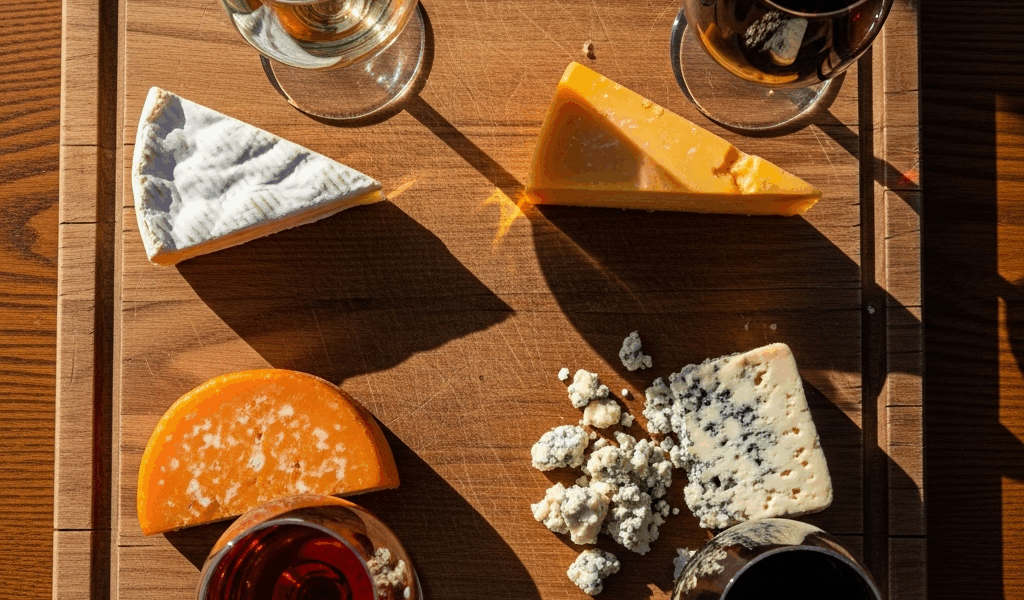
Why Cheese Texture Changes Everything for Wine
Wine and cheese pairing has gotten complicated with all the conflicting advice flying around. Drink what you like. Rules don’t matter. Just go with your gut. And look, some of that is fine — but it’s also how you end up with a $45 Cabernet making a perfectly good Brie taste like bitter chalk.
As someone who spent three years behind the counter at a wine shop in Portland, I learned everything there is to know about what actually drives these pairings. Today, I will share it all with you.
The short version: fat, moisture, and salt in cheese interact with tannins and acidity in wine in genuinely predictable ways. Soft, creamy cheeses need high acidity to cut through the fat. Hard, aged cheeses have crystalline salt deposits that soften harsh tannins — which means bold reds suddenly make sense. Blue cheeses demand sweetness or fortification. Washed-rind cheeses, the aggressively funky ones, need aromatic wines that can hold their ground.
Texture is the map. So, without further ado, let’s dive in.
Soft and Creamy Cheeses Like Brie and Camembert
But what is a soft cheese, exactly? In essence, it’s a high-fat, low-salt, culture-forward product that coats your entire palate the second it hits your tongue. But it’s much more than that — it’s also a wine-killer if you pick the wrong bottle.
Brie, Camembert, fresh chèvre, burrata. They’re all working from the same playbook. Your wine has to cut through that richness or the whole thing tastes flat and faintly greasy. That’s what makes high-acidity wines the obvious answer here — and what makes bold reds such a disaster.
Champagne is the no-brainer starting point. Bubbles plus acidity scrub your palate clean between bites, and that dry, stony minerality doesn’t compete with creaminess — it contrasts it. A Brut from Pol Roger or a grower Champagne out of Cramant, somewhere in the $35–50 range, does more work alongside a $12 Trader Joe’s Brie wheel than most people expect.
Sancerre is my second choice. I landed on this by accident at a dinner party — someone showed up with a bottle of Henri Bourgeois Sancerre and I’d bought a triple-cream I was being slightly ambitious about. Paired them together on a whim. The wine’s grapefruit acidity hit the cheese’s mushroomy, fatty undertones in a way that felt almost designed. Chardonnay would have disappeared entirely.
Unoaked Chardonnay does work, though — with a caveat. Skip the California oak bombs. Look for Chablis or something from Mâcon in Burgundy. Chalky, mineral-driven, no butter. A Mâcon-Villages from Louis Jadot runs $15–18 and pairs beautifully with Camembert. That was a $16 discovery that changed how I stock my fridge.
Fresh chèvre deserves its own note. It’s already tangy and acidic, so it doesn’t need the same aggressive acidity push. A light Pinot Blanc or a dry Alsace Riesling around $20–25 lands better than something too sharp.
What doesn’t work: Cabernet Sauvignon, Syrah, Malbec. The tannins cling to the fat and create this drying, almost metallic bitterness. Don’t make my mistake — I made it repeatedly before I stopped pretending I knew better.
Hard and Aged Cheeses Like Cheddar and Manchego
Everything shifts when you move into aged territory. A two-year cheddar, a wedge of Manchego, Gruyère, Comté, Parmigiano-Reggiano — these are dense, crystalline, concentrated. The salt level is dramatically higher. And that salt is actually doing you a favor when it comes to wine pairing.
Frustrated by consistently terrible red wine pairings with cheese, I finally started paying attention to what was different about the cheeses that worked. Turns out the salt crystals in aged cheese interact directly with tannins and smooth them out. A wine that obliterates soft cheese becomes balanced and almost elegant alongside a sharp five-year Vermont Cabot Cheddar. I tested this with a 2019 Caymus Cabernet — $60, so not a casual experiment — and the pairing was seamless in a way I genuinely didn’t predict going in.
Rioja Tempranillo, especially a Reserva or Gran Reserva in the $25–40 range, might be the best option, as hard cheese pairing requires both structural tannin and enough body to match intensity. That is because Spanish oak aging gives the wine an earthiness that echoes the nuttiness already present in aged cheese. It feels like it was designed for this category.
Aged white Burgundy — Meursault, Puligny-Montrachet — is the premium move. These are oaked Chardonnays with real bottle age, developed complexity, and nutty flavors that mirror aged cheese almost directly. You’re looking at $50 and up for anything decent. Worth it if the cheese is equally serious.
Here’s a genuinely counterintuitive one: Parmigiano-Reggiano with dry Amontillado sherry. The wine’s oxidative aging builds this hazelnut, dried-fruit character that sits alongside Parm’s umami without fighting it. Not obvious. Works completely.
Blue Cheeses Like Gorgonzola and Roquefort
Probably should have opened with this section, honestly. Blue cheese pairing is where most people go completely wrong and never figure out why.
The rule: blue cheese needs sweetness or fortification. Full stop. Dry wine amplifies salt and funk and creates this unpleasant metallic aftertaste that makes everyone at the table go quiet in the bad way. I’ve watched people pair Roquefort with dry Sauvignon Blanc and seen their faces do exactly what you’d expect.
Sauternes is the classic answer. Sweet white Bordeaux made from botrytized grapes — noble rot concentrating sugar into honey, caramel, apricot. A pour of Sauternes against a chunk of Roquefort creates this textbook sweet-salty contrast. The wine’s acidity keeps the whole thing from tipping into cloying. Château Guiraud or Château Lafaurie-Peyraguey, standard bottlings around $30–45, is where I’d start.
Tawny Port — 10-year or 20-year — works equally well with Gorgonzola and Stilton. Oxidized, nutty, slightly sweet, medium-bodied. It doesn’t compete with the cheese, it settles in alongside it. A 10-year from Taylor’s or Warre’s runs $25–30. Solid entry point.
Off-dry Riesling is the move if Sauternes feels like too much of a commitment. Mosel Kabinett or Spätlese — I’m apparently a Zilliken person, and Dr. Loosen works for me while other producers never quite hit the same mark — runs $18–25 and gives you enough residual sugar to balance the cheese while the acidity keeps things lively.
That’s what makes sweet wine pairing endearing to us blue cheese enthusiasts — it feels counterintuitive right up until the moment it doesn’t.
Washed-Rind and Funky Cheeses Like Taleggio
Washed-rind cheeses are genuinely the hardest category. These are the aggressive ones — Taleggio, Époisses, Limburger, Muenster. Rinds washed in brine or alcohol during aging. Orange-red coloring. Sometimes sulfurous. Aromas that clear a room before the board even hits the table.
Frustrated by repeated failures pairing these with standard table wines, I started leaning entirely into aromatic alternatives. Delicate wines just get steamrolled. Something with competing aromatic complexity is your only real option.
Gewürztraminer from Alsace is the gold standard here. Floral, spicy, slightly sweet, aggressively aromatic — and somehow that intensity matches washed-rind funk without conflict. A Trimbach Gewürztraminer, around $20–25, alongside a slice of Taleggio is genuinely one of the better pairings I’ve stumbled into. The wine’s rose-petal and lychee notes play off the cheese’s gamey, fermented character in a way that sounds wrong and tastes right.
Pinot Gris, also from Alsace, works as a lighter alternative. Less aggressive than Gewürztraminer, but still enough body and minerality to hold its ground. This new approach to aromatic pairing took off several years into my tasting experiments and eventually evolved into the framework enthusiasts know and use today — at least in the circles I run in.
Light Pinot Noir — Burgundy-style from cooler regions, or California examples from Santa Lucia Highlands — can work if you stay away from heavily oaked versions. The earthiness connects to the cheese’s funky undertones without triggering the tannin-bitterness problem.
Pale Ale or Saison beer might actually outperform most wines in this category. But if you’re committing to wine, commit to aromatic intensity. Don’t go subtle.
Quick Reference — Cheese and Wine Pairing Summary
- Soft cheeses (Brie, Camembert, Chèvre): Champagne, Sancerre, Chablis
- Hard aged cheeses (Cheddar, Manchego, Gruyère): Cabernet Sauvignon, Rioja Tempranillo, aged Burgundy
- Blue cheeses (Roquefort, Gorgonzola, Stilton): Sauternes, Tawny Port, off-dry Riesling
- Washed-rind cheeses (Taleggio, Époisses): Gewürztraminer, Pinot Gris, light Pinot Noir
While you won’t need a sommelier certification or a $500 wine budget, you will need a handful of go-to bottles and a basic sense of which category your cheese falls into. First, you should identify texture — at least if you want the pairing to make any sense at all. Soft or hard. Creamy or crystalline. Mild or funky. Once you know that, the wine choice stops being guesswork and starts being obvious. Pick the category. Grab one of the bottles. Taste the difference. Honestly, that’s the whole thing.



Stay in the loop
Get the latest pairing with wine updates delivered to your inbox.