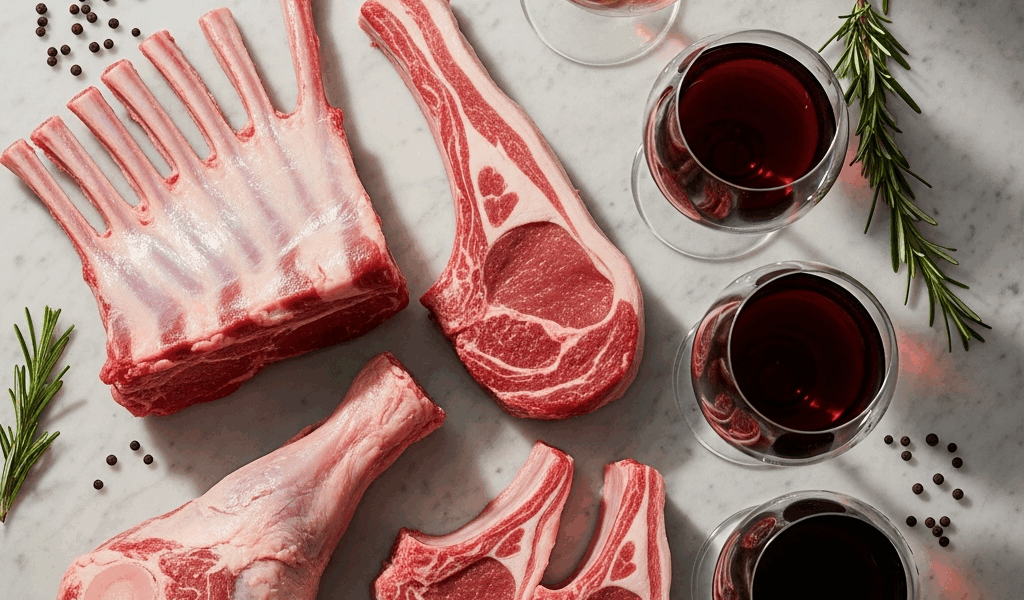
Why Lamb Cut and Cooking Method Change Everything
Wine pairing with lamb has gotten complicated with all the conflicting advice flying around. Ask three sommeliers, get four answers. As someone who spent three years behind the counter at a wine retail shop, I learned everything there is to know about this particular mismatch — mostly by getting it wrong first. Today, I will share it all with you.
For most of that time, I handed customers a Cabernet and called it solved. Worked maybe 60% of the time. The other 40%? They’d come back annoyed — sometimes genuinely irritated — because the wine steamrolled a delicate grilled chop or felt weirdly thin against a four-hour braised shank. That gap bothered me enough that I started actually paying attention.
But what is a lamb pairing problem, really? In essence, it’s a fat-and-char equation that shifts depending on preparation. But it’s much more than that. A rosemary-crusted rack of lamb and a red wine braised shank share almost nothing in terms of what they need from a glass. Different fat levels. Different char profiles. Completely different sauce situations. That’s what makes lamb endearing to us food-and-wine obsessives — it punishes lazy thinking and rewards specificity. So, without further ado, let’s dive in.
Rack of Lamb and Wine Pairings
Rack of lamb is the showpiece cut. The one you cook when someone’s parents are visiting. Usually it comes out of a 425°F oven wearing an herb crust — thyme, rosemary, garlic pressed into Dijon — and that crust is doing serious work on the pairing side.
Cabernet Sauvignon is the obvious call, and honestly, it earns that reputation. A Napa or Left Bank Bordeaux Cabernet brings tannin that cuts through rendered fat without erasing the meat’s flavor. Those herbal notes — pencil shavings, dried sage — echo the rosemary on the crust in a way that feels intentional. I’ve had better results with bottles in the $30–50 range than with anything precious. The 2019 Freemark Abbey Napa Cabernet Sauvignon sits right around $38 and handles this preparation exactly as advertised — structured, not overbuilt, no overwhelming oak finish.
Syrah is my actual preference here, though. Probably should have opened with this section, honestly. Most restaurants default to Cabernet and customers assume it’s the only lane worth driving in. Syrah brings cracked black pepper and darker fruit — blackberry, olive tapenade — that play beautifully against herb-crusted lamb without the same aggressive tannin wall. A Côtes du Rhône works fine on a weeknight. Splurge slightly and a Crozes-Hermitage hits a completely different register. The 2020 Jaboulet Crozes-Hermitage runs around $18 at most wine shops and outperforms bottles at twice the price against this specific preparation. I’m apparently a Rhône person and this bottle works for me while expensive Napa Cabernet never quite does with herb-crusted lamb.
Tempranillo rounds out the options if you want something earthier without going full Northern Rhône. A reserva-level Rioja — one that’s spent meaningful time in American oak — develops enough complexity to handle the richness. The 2017 Marqués de Cáceres Rioja Reserva pairs cleanly and stays under $25. Don’t overthink it.
Skip the light Pinots. Skip the oaky Chardonnays too. The white wine instinct is understandable — lamb sounds delicate on paper — but it’s wrong in execution. Fat needs tannin. Heavily oaked whites go bitter against this dish and leave you wondering what went sideways. Don’t make my mistake.
Braised Lamb Shank Wine Pairings
Braised lamb shank occupies a different universe entirely. Three to four hours in a low oven — 325°F, usually — submerged in red wine, stock, crushed tomatoes, and its own rendered fat. The meat surrenders completely. Falls off the bone with a spoon’s pressure. The braising liquid reduces into something almost unctuous.
This is the one situation where a jammier, bigger red actually belongs on the table. Grenache-based blends from the Southern Rhône were built for exactly this. Frustrated by thin, acidic wines that clanged against rich sauces, generations of Provençal winemakers developed fruit-forward, full-bodied reds using sun-drenched Grenache as the backbone — and those wines found their perfect match in slow-braised meat. The 2019 E. Guigal Châteauneuf-du-Pape runs about $45 and tastes like it was designed specifically for lamb shank. Because, in a way, it was.
Aged Rioja reserva is my runner-up here — the real runner-up, not a consolation. Bottles with 3-plus years of aging develop softness and complexity that braised lamb demands. Tannins have mellowed out completely. Oak integrates rather than announces itself. A 2015 or 2016 López de Heredia drinks beautifully with this preparation and lands around $30–40 depending on where you shop.
Gigondas might be the best budget option, as braised lamb requires body and fruit depth. That is because the sauce is already wine-adjacent — built from stock and red wine reduction — and needs a glass that meets it at that level rather than fighting it. The 2020 Domaine du Vieux Télégraphe Gigondas pairs excellently and sits around $32. Less famous than Châteauneuf-du-Pape, same Grenache-dominant structure, noticeably lower price.
The braising liquid is your secret weapon with this cut. That reduced sauce acts as a bridge — at least if you’ve built it properly with wine and good stock. The acidity in the sauce calibrates with the acidity in the glass. The wine doesn’t carry the whole load alone. This is why big, fruit-forward reds succeed here when they’d completely overwhelm a rack.
Grilled Lamb Chops Wine Pairings
Grilled lamb chops are the third scenario — separate from the other two in almost every meaningful way. Direct heat. Char. Smoke. Quick cook, maybe four minutes per side over screaming hot coals. The meat stays pink and tender inside while the surface crusts up. Fat renders and crisps at the edges. Usually no sauce involved — just salt, maybe flaky Maldon, maybe a squeeze of lemon.
Malbec thrives here. Smoke and char find their match in Malbec’s dark plum fruit and moderate tannin — present enough to handle the fat, soft enough not to clash with the char. Mendoza Malbec from Argentina specifically is the crowd-pleaser at accessible prices. The 2021 Luigi Bosca Malbec costs about $20 and performs like a $40 bottle against grilled lamb. I’ve tested this pairing more times than I can count. Cahors Malbec from France works too, though it runs spendier without necessarily delivering a better result for this particular dish.
Cabernet Franc earns serious consideration here. Less tannic than Cabernet Sauvignon, more aromatic, with smoke-friendly herbal notes — green pepper, crushed gravel, dried violet — that cut through char rather than compete with it. A Loire Valley Cabernet Franc from Bourgueil or Chinon hits an elegant register without feeling precious or fussy. The 2020 Domaine Druet Chinon runs $28–32 and pairs beautifully. This new wave of Loire Cab Franc appreciation took off several years back and eventually evolved into the go-to grilled lamb recommendation that enthusiasts know and love today.
Here’s where people get surprised: rosé earns a legitimate seat at this table — at least if you’re grilling outdoors in warm weather. A dry Provence rosé brings real acidity and actual tannin structure (yes, rosé has tannin — more than most people realize) capable of handling char. I’m apparently a rosé skeptic by default and Whispering Angel at around $15 works for me against grilled lamb while most cheap rosés never do. It’s not a compromise recommendation. It genuinely competes.
Quick Pairing Reference by Cut
- Rack of Lamb — Roasted with Herbs → Cabernet Sauvignon or Syrah. Tannin cuts fat, herbal notes echo the crust.
- Rack of Lamb — Roasted with Herbs (Budget Option) → Tempranillo (Rioja Reserva). Earthier alternative, stays under $25.
- Lamb Shank — Braised in Red Wine → Grenache-based Southern Rhône (Châteauneuf-du-Pape, Gigondas). Fruit-forward body matches sauce depth.
- Lamb Shank — Braised in Red Wine (Budget Option) → Aged Rioja Reserva. Tannins mellowed, oak fully integrated.
- Lamb Chops — Grilled → Malbec (Mendoza preferred). Smoke and char match perfectly, accessible pricing around $20.
- Lamb Chops — Grilled (Alternative) → Cabernet Franc (Loire Valley). Less aggressive than Cabernet Sauvignon, herbal complexity adds real dimension.
- Lamb Chops — Grilled (Warm Weather Option) → Dry Provence Rosé. Genuine tannin structure, refreshing acidity, holds up against char without weighing down a warm evening.

Stay in the loop
Get the latest pairing with wine updates delivered to your inbox.