Why Cooking Method Changes Everything
Pairing wine with salmon has gotten complicated with all the generic “just drink white wine” noise flying around. As someone who spent three years working the line at a farm-to-table restaurant in Portland, I learned everything there is to know about this subject. Today, I will share it all with you.
The turning point came during a staff tasting. Our sommelier poured the same Pinot Grigio alongside five different salmon preparations. One pairing was flawless. Four were genuinely painful. That’s when it clicked — what wine pairs with salmon isn’t just about the fish. It’s about what you did to it first.
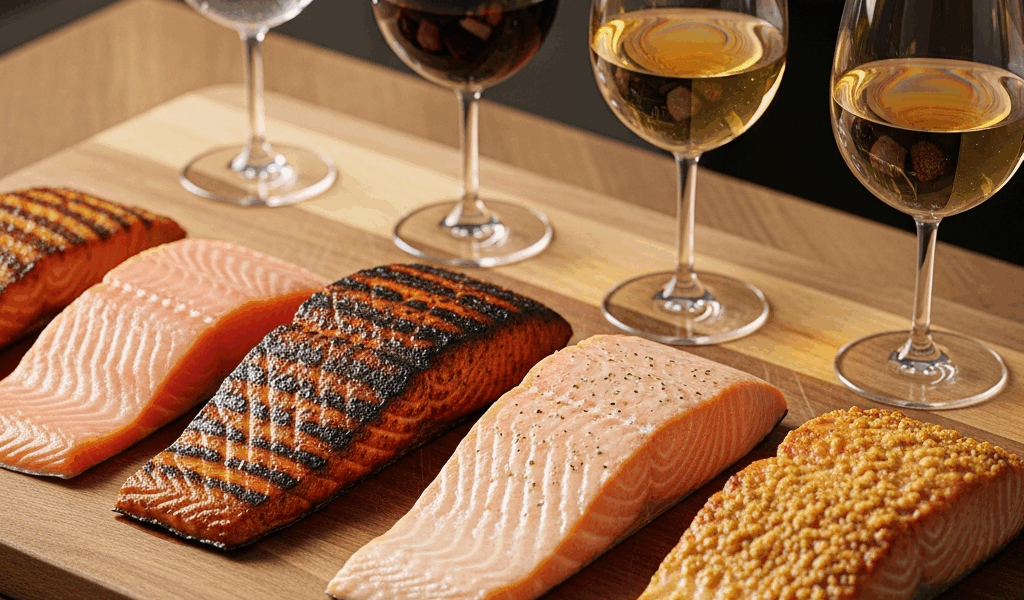
Here’s the short version. Grilling adds char and smoky compounds. Those demand weight. Poaching keeps everything delicate and subtle — restraint in the glass is your only move there. Smoking concentrates salt, fat, and umami to almost aggressive levels. Raw preparations like crudo or tartare are basically neutral canvases. Each situation is structurally different. Skip this framework and you’re pairing blind, essentially wasting a $45 bottle on a coin flip.
Grilled Salmon and Wine
Grilled salmon is probably the most forgiving preparation here. That’s what makes it endearing to home cooks and steakhouse menus alike — there’s some wiggle room. Still, knowing where the guardrails are matters.
The char creates bitter, savory compounds. The exterior oils render and caramelize against the grates. Inside, the flesh stays moist. That combination needs a wine with actual body and a little oak character to mirror what’s happening on the surface.
A lightly oaked Chardonnay from California’s Central Coast does the job well — something like a Babcock or a Duckhorn from Napa, usually sitting around $28–45. The oak echoes the char. The medium body handles the rendered fat. Acidity stays present without thinning everything out. It’s not a complicated call once you understand the logic.
Pinot Noir might actually edge out the Chardonnay if you’re grilling over hardwood. I default to Willamette Valley — Cristom, Elk Cove, something from a cooler site. The red-fruit core bridges the smoky char and the salmon’s natural delicacy in a way that feels almost intuitive. Enough tannin structure to handle the fat, not so much that it bulldozes the fish.
Probably should have opened with this section, honestly, because grilling is where most people go wrong. They see char marks and assume “serious red wine.” They reach for the Cabernet. That’s the mistake — the salmon is still salmon. Heavily tannic reds compete with the fish oils instead of working alongside them. Don’t make my mistake.
One pairing that stuck with me specifically: cedar-planked salmon at a restaurant on Seattle’s waterfront, paired with a 2019 Cristom Pinot Noir from the Willamette Valley. The cedar smoke in the fish and the wine’s red-cherry backbone created something almost supernatural. It was also twenty dollars cheaper than the white wine option on the list. Easy call.
Smoked Salmon and Wine
Smoked salmon is the heavyweight. But what is smoked salmon, structurally speaking? In essence, it’s hours in a smoking chamber — high heat, fat oxidizing, surface turning almost leathery, salt content spiking to levels that will destroy a delicate wine. But it’s much more than that. It’s also bagels and lox on a Sunday morning, or an elegant plated appetizer under a tasting menu’s first course. Either context demands the same structural response from the wine.
High-acid, mineral-forward. That’s the only direction that works here.
Champagne is the classic answer — and it earns that reputation. The bubbles physically scrub your palate between bites. The acidity cuts salt and fat without confusion or muddiness. A Brut from Taittinger or Billecart-Salmon — the irony of that producer name isn’t lost on me — runs $50–70 and will absolutely demolish a plate of smoked salmon in the best possible way.
Chablis might be the best everyday option, as smoked salmon requires real mineral backbone and high acidity without oak interference. That is because unoaked Chardonnay from the chalk-limestone soils around Chablis in Burgundy delivers exactly that cutting quality Champagne offers, minus the bubbles and usually minus $15–20 off the price. A Premier Cru from William Fèvre hits the sweet spot between complexity and value — typically around $35–45 depending on the vintage.
Dry Alsatian Riesling works too. The mineral edge and pronounced acidity create a contrast that sharpens both the wine and the fish. Strangely, the salinity in the wine echoes the salt in the smoked salmon — sounds counterintuitive until you actually taste it side by side.
I’m apparently sensitive to over-oaked whites, and a heavily oaked California Chardonnay never works for me with smoked salmon. Tried it once. It tasted like wood shavings soaked in brine. That was 2018. Haven’t touched that pairing since.
Pan-Seared and Poached Salmon and Wine
These two preparations sit at opposite ends of the richness spectrum — but covering them together makes sense because the underlying logic connects them.
Pan-seared salmon gets crispy golden skin, rendered fat, moist interior flesh. It’s richer than poached, less assertive than grilled. The wine needs to match that rendered exterior without flattening the delicate center.
Viognier from the Rhône Valley — something like a Yves Cuilleron around $30 — mirrors the rendered fat with its fuller body and stone-fruit character. White Burgundy at the Meursault or Puligny-Montrachet level does the same job with more mineral structure. The floral character in a good Viognier complements the salmon’s natural sweetness in a way that feels almost effortless.
Poached salmon is a different animal entirely. Pale, silky, almost translucent flesh. No char, no crust, no rendered fat — just quiet, gentle protein and subtle fat content that a heavy wine will completely bury.
Pinot Gris from Alsace pairs quietly and elegantly here — not the bulk grocery-store versions, but something with actual structure like a Trimbach Réserve, usually around $22–28. Dry Provençal Rosé, light and mineral-forward, handles poached salmon beautifully without competing. An unoaked Chablis lets the salmon do its thing undisturbed.
Raw Salmon — Crudo and Tartare
Raw salmon is nearly neutral — buttery, mildly sweet, with almost no umami or mineral edge of its own. That’s what makes it a delicate canvas. That’s what makes raw preparations endearing to us wine-pairing obsessives, actually, because the wine carries more of the conversation.
So, without further ado, let’s dive in — crisp, high-acid whites with actual salinity are the move. Albariño from Rías Baixas in Spain, Muscadet from the Loire Valley, or a lean Vermentino from Sardinia. Each one creates contrast without bulldozing the fish. The acidity cuts through the richness of raw salmon oil. The salinity in the wine amplifies the clean, oceanic quality of a well-prepared crudo.
While you won’t need to spend serious money here, you will need a handful of specific producers rather than grabbing random bottles. Most of these sit in the $20–35 range. For Albariño, look at Pazo Senoráns or Do Ferreiro. For Muscadet, Domaine de la Pépière makes consistently excellent bottles around $18–22.
Quick Pairing Reference by Cooking Method
- Grilled Salmon — Pinot Noir (Oregon or Burgundy) or lightly oaked Chardonnay
- Smoked Salmon — Champagne, Chablis, or dry Alsatian Riesling
- Pan-Seared Salmon — Viognier or white Burgundy (Meursault tier)
- Poached Salmon — Dry Rosé, Pinot Gris, or unoaked Chardonnay
- Raw Salmon (Crudo/Tartare) — Albariño, Muscadet, or Vermentino
Next time you’re planning a salmon dinner — or squinting at a wine list mid-meal trying to remember what you ordered — skip the generic white-wine-with-fish reflex. Know the cooking method first. The right bottle becomes obvious from there.


Stay in the loop
Get the latest pairing with wine updates delivered to your inbox.