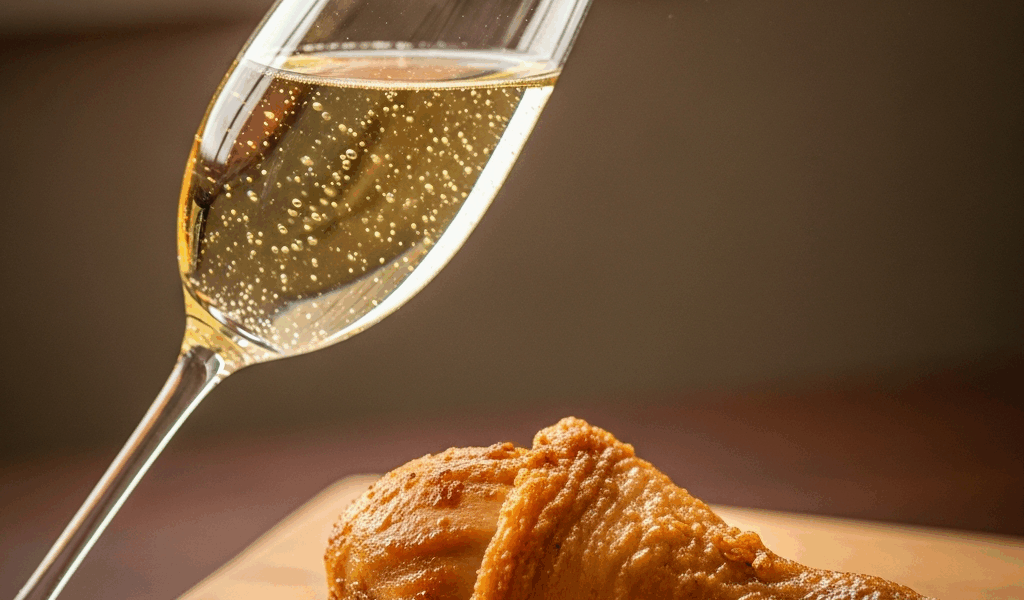
Why Fried Chicken Is Tricky to Pair With Wine
Wine pairing with fried chicken has gotten complicated with all the conflicting advice flying around. As someone who has shown up to enough potlucks with the completely wrong bottle, I learned everything there is to know about this particular food-and-wine disaster. Today, I will share it all with you.
So here’s the thing nobody says plainly: fat kills wine. Specifically, it murders tannins. That glorious grease coating on fried chicken — the stuff that makes it worth eating — coats your palate right along with it. When that fat collides with the drying compounds in a heavy red, something genuinely unpleasant happens. The tannins spike. The wine goes bitter. Flat. Sometimes almost metallic. You end up blaming the bottle when really you just brought the wrong wine to a fried chicken situation.
Salt makes everything worse. Fried chicken is salty — properly, aggressively salty, exactly as it should be. That salt suppresses fruit flavors in wine. A bottle that tasted bright and lively on its own suddenly tastes thin and sharp the moment it meets a salty, crispy crust. High frying temperatures also introduce faint char notes that clash hard against delicate fruit profiles.
Then there’s the variation problem. Spicy rub? Hot sauce? Honey glaze? Each one introduces entirely different flavor compounds that need their own pairing logic. Nashville hot chicken is not the same pairing challenge as a classic buttermilk drumstick. That’s what makes fried chicken so endearing to us food people — it’s endlessly varied — but it’s also where most pairing guides fall apart completely. They treat all fried chicken like one thing. It is absolutely not.
The answer isn’t to skip wine entirely, though. It’s to pick wines that fight the fat rather than surrender to it. So, without further ado, let’s dive in.
The Best Wines for Fried Chicken and Why They Work
Champagne or Crémant — The Safe Bet
Carbonation physically scrubs fat off your palate. The bubbles create actual texture and reset your mouth between bites, so each piece tastes fresh rather than progressively heavier. This isn’t romantic — it’s mechanical. A solid Champagne runs $40–$60. Or grab a Crémant d’Alsace for $15–$25 and get the same effect without the ceremony.
The acidity in sparkling wine brightens the salt in the chicken rather than fighting it. I stumbled onto this when a friend showed up to a cookout with a bottle of Pol Roger NV and I suddenly understood why restaurants pair champagne with fried appetizers. It wasn’t pretentious. It was practical.
Dry Riesling — The Underrated Choice
But what is dry Riesling, really? In essence, it’s a high-acid, low-alcohol white wine — usually sitting around 11–12% ABV — that lifts salt from food without adding heat or bitterness. But it’s much more than that. The citrus edge doesn’t compete with a savory crust; it works alongside it in a way that feels almost designed. A dry Riesling from Alsace or the Mosel region runs $12–$20 and routinely outperforms wines twice the price.
People assume Riesling means sweet. Dry Riesling is not sweet. Check the label. Ask the person at the shop. Don’t make my mistake of grabbing whatever had a nice label and ending up with something cloying.
Beaujolais — Low Tannin, High Fruit
Beaujolais is technically a red. Doesn’t behave like one. It’s fruit-forward, low in tannins, and usually served slightly chilled — around 55°F if you want to be precise about it. Because the tannin load is so low, it won’t amplify the fat’s astringency. The fruit profile — red berries, a little plum, sometimes fresh cherry — doesn’t clash with savory chicken. It just sits alongside it comfortably. Around $10–$18 a bottle. No caveats required.
A young Beaujolais, especially Beaujolais Nouveau, is specifically built to be approachable and immediate. That’s exactly what you want here.
Off-Dry Rosé — The Crowd-Pleaser
Rosé lives between red and white in terms of acidity and tannin. An off-dry version — one with just a touch of residual sugar, usually under 2 grams per liter — handles both salt and heat better than a completely bone-dry style. Provençal rosé is the standard reference point, $12–$22, but honestly a Spanish rosado works just as well and usually costs a few dollars less.
The touch of sweetness doesn’t take over. It just softens the edges. People consistently enjoy rosé with fried chicken more than they expect to, which matters when you’re actually feeding a group of real humans who have opinions.
Gewürztraminer — For Spicy Versions Only
This one comes with conditions. Gewürztraminer is aromatic and slightly sweet, with lower acidity than Riesling — on paper, kind of wrong for fried chicken. But if your bird is coated in cayenne, chili powder, paprika, or anything with serious heat, Gewürztraminer’s floral character and off-dry finish can balance the spice in ways a dry wine simply cannot manage. Around $14–$20 a bottle. Use it specifically. Don’t just reach for it at random.
Does It Change If the Chicken Is Spicy or Sauced
Absolutely. Probably should have opened with this section, honestly.
Classic buttermilk-fried chicken with mild seasoning: Champagne or dry rosé. Cut the fat, brighten the salt, done. No complexity needed.
Nashville hot or anything with serious heat: Off-dry Riesling or Gewürztraminer. The residual sugar cools the spice and keeps the high-alcohol burn from compounding the heat already in your mouth. I’m apparently the person who once paired Nashville hot with a bone-dry Sauvignon Blanc and spent ten minutes questioning every decision that led me there. Don’t make my mistake.
Honey-glazed or teriyaki-style fried chicken: Slightly off-dry Riesling or a pet-nat — a lightly sparkling natural wine, usually $12–$18 — works better than anything aggressively tart here. The sweetness in the glaze already shifts how acidity reads on your palate. The bubbles in a pet-nat cut through caramelized sugar clinging to the meat. It’s a quieter pairing, but it works consistently.
Korean fried chicken with gochujang sauce: Gewürztraminer or pet-nat. Korean fried chicken is often double-fried, which makes it extra crispy and significantly more fat-forward than a single-fried version. Add fermented chili sauce on top of that and you need acidity and slight sweetness at the same time — a combination that’s rare in wine. Pet-nat delivers it in a way that feels fun rather than calculated.
Wines to Avoid With Fried Chicken
- Cabernet Sauvignon and other full-bodied reds: Tannins turn astringent against fat. The wine suffers, not the chicken.
- Barolo and other high-tannin reds: Worse than Cabernet in this context. These wines genuinely need low-fat food to show their structure without turning harsh.
- Oaky Chardonnay: The oak competes directly with the crispy crust. You end up tasting neither thing clearly.
- High-alcohol wines above 14% ABV: Heat amplifies spice. If your chicken has any kick, a 15% Pinot Noir will make your mouth feel like a crime scene.
- Bone-dry Sauvignon Blanc: Too aggressive against salt and fat together. The acidity tips from refreshing into almost painful.
- Port or dessert wines: Just confuse everything. Fried chicken is not a dessert.
Quick Pairing Guide by Fried Chicken Style
- Southern classic (buttermilk, mild spices): Champagne, Crémant, or dry rosé
- Nashville hot: Off-dry Riesling or Gewürztraminer
- Korean fried chicken: Gewürztraminer or pet-nat
- Buttermilk sandwich: Dry rosé or Beaujolais
- Honey or teriyaki-glazed: Off-dry Riesling or pet-nat
- Blackened or heavily seasoned: Beaujolais or dry Riesling
Here’s the practical reality: you’re planning a meal right now. Probably shopping for wine within the hour. Skip the instinct to grab red just because it feels traditional — that instinct will cost you a $30 bottle that tastes thin and bitter against your chicken. Grab something with bubbles or serious acidity, figure out how spicy your chicken actually is, and buy accordingly. Both the wine and the meal will taste like they were supposed to.


Stay in the loop
Get the latest pairing with wine updates delivered to your inbox.